
Table of Contents
Okay, real talk—have you ever wondered why some weeks you’re absolutely crushing it at the gym, feeling social and confident, and then other weeks you just want to curl up with a heating pad and pretend the world doesn’t exist? Yeah, you’re not losing your mind. Your body’s doing its thing on a monthly rhythm, and once you understand it, everything changes.
Cycle syncing is basically the practice of working with your cycle instead of pretending it doesn’t exist. Sounds simple, but it’s honestly life-changing. It’s about eating the right stuff at the right time, exercising smarter instead of harder, and scheduling your big meetings and personal projects when you’re actually at your peak. No more forcing yourself through workouts when your body’s begging for rest, or wondering why you can’t focus during the week you swore you’d crush a project.
Think of your cycle like seasons in a year. Winter, spring, summer, fall—each one’s got its own vibe and what you need to thrive is different in each. Same with your cycle. Once you figure out which season you’re in, you can actually work with your body instead of feeling like you’re constantly swimming upstream.
What’s Cycle Syncing, Anyway?
So here’s the thing that nobody really talks about: your body doesn’t just run on a 24-hour clock like everyone assumes. If you menstruate, you’ve also got this other biological rhythm running underneath it all—kind of like having two operating systems running at the same time. This 28-to-35-day rhythm is called your infradian rhythm, and honestly, it’s just as important as your daily sleep-wake cycle.
Functional nutritionist Alisa Vitti basically pioneered this whole approach with something called the E-E-A-T framework, and it’s become this game-changing way for people to think about their health. Instead of forcing yourself to be the same person every single day of the month, you’re actually working with the four distinct phases your body goes through.
The Four Phases (Make Them Your Best Friends)
Your cycle breaks down into four phases, each one lasting about a week or so. Here’s what’s actually happening in your body:

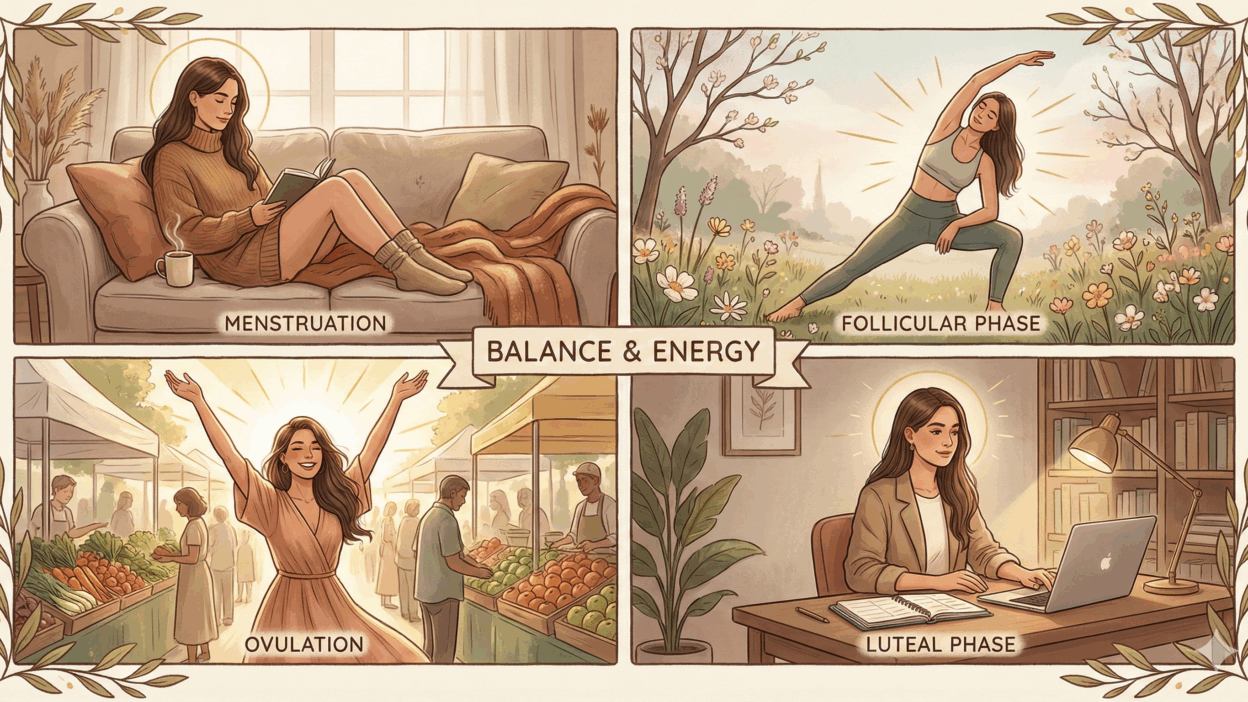
Menstruation (Days 1-5): Your period’s here, and your body’s basically telling you to slow down. Hormones drop, and this is your internal winter. Your energy is lower, you’re more introspective, and honestly? Your body’s just asking for rest and comfort. This isn’t weakness—this is wisdom. Treat yourself accordingly.

Follicular Phase (Days 6-14): Your period’s wrapping up and your estrogen’s starting to climb. Hello, spring energy! You’re feeling more outgoing, creative ideas are flowing, and you’ve got this natural optimism bubbling up. This is when you want to start new projects, make big plans, and say yes to social stuff.

Ovulation (Days 15-17): This is your peak week. Estrogen’s at its highest, testosterone’s up, and you’re basically superhuman. This is your summer—your confidence is through the roof, you’re the most social version of yourself, and you can take on literally anything. Schedule your big presentation or important conversation this week.

Luteal Phase (Days 18-28): After ovulation, progesterone rises and things start to shift. Your metabolism actually increases (yes, you’ll be hungrier—that’s normal), and your energy naturally turns inward. This phase has two parts: the earlier part where you’re still pretty functional and focused, and the later part (premenstrual) where you might feel a bit more irritable or tired. This is your autumn—think planning, organizing, wrapping things up. Your brain’s actually better at detail work and problem-solving right now.
Why This Actually Works (The Real Deal)
Here’s what blew my mind when I first learned about this: it’s not pseudoscience. There’s legit research backing this up. Your metabolism genuinely shifts throughout your cycle—we’re talking an extra 100-300 calories your body burns during the luteal phase. That’s not nothing.
Your muscles actually perform differently depending on where you are in your cycle too. During the follicular and ovulatory phases, you’ve got better strength and power. During the luteal phase, your endurance is actually better. So when you see people talking about how some weeks they crush their workouts and other weeks feel sluggish? That’s real, and it’s not because they’re doing anything wrong.
Even your brain changes throughout the month. During your follicular and ovulatory phases, you’re better at verbal stuff, socializing, and quick thinking. During your luteal phase, you’re actually better at detail-oriented work, planning, and problem-solving. It’s like your brain’s got different superpowers depending on the week.
And here’s the thing that actually matters: when people sync up with their cycle, they report feeling 25-40% more productive when they schedule work that matches their phase. Plus, that whole PMS nightmare? People report like an 83% reduction in symptoms when they start eating strategically for their cycle. That’s not placebo—that’s actual results.
The Infradian Rhythm Explained (Without the Jargon)
Okay, so I mentioned the infradian rhythm earlier. Let me break this down because it’s actually the key to understanding why all of this works.
Your circadian rhythm—that’s your 24-hour body clock that makes you sleepy at night and hungry at lunch—that’s the thing everyone knows about. It’s legit, it won science awards, it’s a big deal.
But here’s what most people don’t realize: if you menstruate, you’ve also got this other rhythm layered on top of it. It’s approximately 28-35 days, and it’s controlling stuff like your metabolism, your hormone levels, your brain chemistry, and how fast you recover from exercise. For about half your life, this rhythm is just as important as your circadian rhythm, but nobody really teaches us about it.
The problem is that basically everything in modern life—workouts, eating plans, work schedules, productivity hacks—is designed assuming everyone’s got the same biology every single day. It’s all based on the circadian rhythm and basically ignores the infradian rhythm entirely.
So what happens when you try to follow a man’s fitness program, eat the same calories every day, or push yourself equally hard all month? You’re fighting biology. And fighting biology is exhausting. You end up tired all the time, injured during certain weeks, unable to lose weight, moody, bloated… the whole frustrating cycle (pun intended).
When you actually recognize and work with your infradian rhythm? Everything gets easier. You’re not working harder—you’re working smarter.
Proof It Actually Works
The reason I’m actually convinced about cycle syncing isn’t just because it sounds cool—it’s because the results speak for themselves.
Your Metabolism Actually Changes
Your body literally burns more calories during the luteal phase. That’s not a myth or an excuse—that’s biology. So when you’re following the same fitness routine and eating the same amount during this phase, you’re working with your body instead of against it. People who sync their nutrition to their cycle and adjust their calorie intake accordingly report way better results than people just doing generic “eat less, move more” advice.
Athletic Performance Shifts
Athletes have started paying attention to this stuff big time. Your muscles have peak performance windows. During your follicular and ovulatory phases, you’re genuinely stronger and more powerful. During your luteal phase, you’ve got better endurance. So instead of doing the same thing every week and wondering why some weeks feel impossible, you can actually plan your workouts strategically. Schedule your heavy lifting and high-intensity stuff during your peak weeks, and do maintenance and recovery-focused training during the luteal phase. People see way fewer injuries and actually get better results.
Your Brain Works Differently
This one’s kind of wild. During your follicular and ovulatory phases, you’re better at social stuff, creative thinking, and quick decision-making. During your luteal phase, you’re actually better at deep focus, analyzing details, and problem-solving. So if you’ve got a big presentation or negotiation? Aim for your ovulatory phase. If you need to sit down and work through a complex problem or do detailed planning? Your luteal phase is actually better for that, even if your energy feels lower.
People who start scheduling their work around this stuff report getting like 25-40% more done. And that makes sense when you think about it—you’re working when your brain’s actually optimized for that type of work.
Your Digestion Actually Cooperates
Your gut is genuinely different throughout your cycle. Your microbiome changes, your stomach acid levels shift, and you digest things differently. During your follicular phase, your digestion’s pretty much optimal. During your luteal phase, you need a bit more support. When people start eating strategically for their phase—anti-inflammatory foods during the luteal phase, better nutrient absorption during the follicular phase—the bloating goes away, digestion improves, and you actually absorb more nutrients. It’s not magic; it’s just biology.
The PMS Situation Actually Improves
Here’s the part people actually care about: when people start cycle syncing, PMS symptoms drop significantly. We’re talking 90% of people eating better and 83% reporting way less bloating, cramping, mood swings, and brain fog. That’s huge. You’re not popping extra painkillers or white-knuckling through your week—you’re actually preventing a lot of the discomfort by eating and moving in ways that support what your body actually needs.
How to Actually Do This
Okay, so you want to try it. Great! Don’t stress about doing it perfectly. Start small and build from there.
Step 1: Actually Track Your Cycle
Grab an app (Flo, Natural Cycles, or literally just use your phone’s calendar) and start paying attention to when your period starts and ends. If you can notice ovulation signs (sometimes people get a tiny temperature rise, or their cervical mucus changes—yeah, it’s a thing), even better. But honestly, just knowing your period dates is enough to get started. Do this for like two months so you can spot patterns.
Step 2: Notice What’s Actually Happening
As you’re tracking, pay attention to your own experience. When do you genuinely feel most energetic? When do you need more rest? When do tasks feel easy versus impossible? When do you actually want to go out versus wanting to stay in? This is way more important than any generic advice because it’s your specific cycle. Everyone’s a little different.
Step 3: Eat for Your Phase
Here’s where the rubber meets the road:
- Menstruation: Load up on iron (red meat, spinach, lentils), magnesium (pumpkin seeds, dark chocolate), and warm, comforting food. Your body needs the fuel. Eat a bit more—your metabolism’s shifting anyway.
- Follicular Phase: Fresh veggies, lean proteins, whole grains. Your digestion’s working great right now, so take advantage. Eat lighter but pack it with nutrients.
- Ovulation: Bump up the protein because your metabolism’s higher. Load up on antioxidants (berries, leafy greens) to handle the inflammatory response that comes with the hormonal surge.
- Luteal Phase: Complex carbs are your friend now (sweet potatoes, oats, brown rice). Add in healthy fats (avocado, nuts, olive oil) and anti-inflammatory foods (fatty fish, broccoli, Brussels sprouts). Your body literally needs more calories right now—work with that.
Step 4: Move Your Body Smarter
- Menstruation: Go easy on yourself. Restorative yoga, walks, swimming, gentle stretching. Your body’s recovering and your energy’s lower. That’s not laziness—that’s listening to your body.
- Follicular Phase: Start ramping things up. This is a great time to start a new fitness program or try something challenging. Your body’s ready.
- Ovulation: Go hard. This is peak performance week. Whatever your most intense workout is? Do it now. Competition? Climbing that hard route? Training for something? This is your week to shine.
- Luteal Phase: Shift to moderate-intensity, steady cardio and strength maintenance. Focus on consistency instead of crushing it. Your body’s actually better at endurance right now anyway.
Step 5: Schedule Your Life Strategically
- Menstruation: Handle your admin tasks, internal meetings, paperwork. This is your planning and reflection week. Don’t schedule your big presentation now.
- Follicular Phase: Brainstorm, launch new projects, plan strategy. Your creativity’s at peak levels. Say yes to that networking event or collaborative work.
- Ovulation: Book your big presentations, important client meetings, negotiations. Schedule your difficult conversations now when you’re most confident and articulate. This is your week to shine professionally.
- Luteal Phase: Execute those plans, dig into detailed work, solve complex problems, do analysis. Your brain’s actually wired for this right now. Get those systems in place, do your admin catch-up from earlier in the cycle, and plan for the next month.
Wrapping Up: Your Cycle Isn’t the Enemy
Here’s the thing I wish someone had told me earlier: your cycle isn’t something to overcome or apologize for. It’s not a limitation—it’s actually a feature. When you work with it instead of against it, you’re not doing less. You’re actually doing more by being strategic about it.
The science is solid. Your cycle creates real, measurable differences in how your body performs, what your brain’s good at, and what you actually need. Fighting that is exhausting and pointless. Working with it? That’s when life actually gets easier.
Start small. Track for a couple months. Notice what’s happening. Make one change at a time. Over time, cycle syncing stops being something you have to think about and becomes just how you naturally move through your month—with way more energy, less struggle, and a lot more compassion for yourself.
Your cycle isn’t a bug. It’s actually kind of a superpower. Time to start using it like one.